World’s Biggest and Largest Spiders Ever Seen!

Have you ever wondered how big the world’s biggest spiders are? Lots of us get scared even at the sight of a small, harmless spider, but imagine meeting a gigantic spider… Now that will just creep the living daylights out of you. Now we all know that size doesn’t matter, but when it comes to spiders, the bigger they are, the scarier they become. Let’s have a look at some of the biggest spiders in the world and see just how large they really are.
South American Goliath Birdeater Tarantula (30 cm)
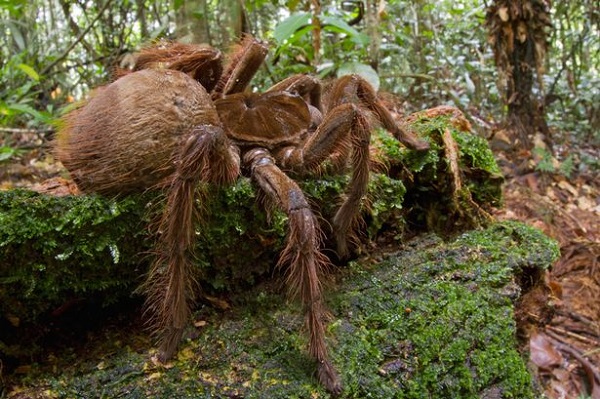
The amazing exemplar with fangs of 2 inches was found by Piotr Naskreckise in a jungle from South America. He was amazed when he saw the puppy-sized tarantula. It weights about 170 grams and despite its name, the furry monster feeds with frogs, rodents, lizards and snakes. Also, its venom is very potent.
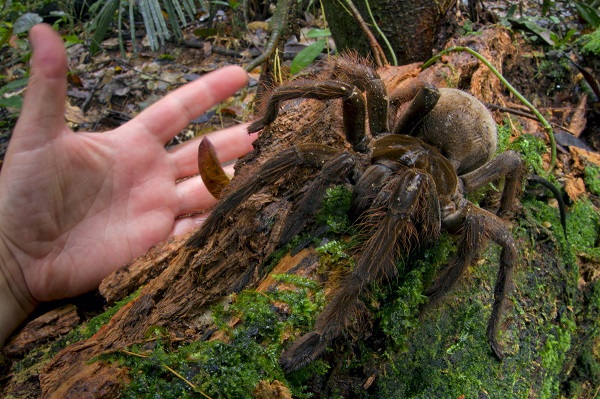
We have this species of tarantula at nr. 9 in our top, since its average size is 25,4 cm.
Here is the top of the largest spiders ever seen on earth.
1. Huntsman Spider: 30 cm

These ugly creatures get their name from the fact that they are very agile when stalking prey. They also are called giant crab spiders, because of their amazing size and shape. Luckily, they are not harmful for humans, though they have been known to inflict defensive bites.
2. Lasiodora parahybana Brazilian Salmon Pink: 27 cm

The Brazilian Salmon Pink Bird-eating Tarantula is commonly found in Brazil and it was first discovered in 1917, near a city where it was endemic, namely, Campina Grande, Paraíba. Now they are very common as pets.
3. Goliath Birdeater Spider: 25,4 cm

This humongous arachnid belongs to the tarantula Theraphosidae family and it’s considered the second largest spider in the world. Some specimns have reportedly been seen gulping up humming birds, so that’s what gave them the “birdeater” nickname. These spiders have a leg span of up to 30 cm (12 inches) and may weigh more than 170 g (6 ounces). Thir bite is harmless to humans despite their scary fangs, therefore, these spiders make great pets for spider fans.
4. Camel Spider: 15,4 cm
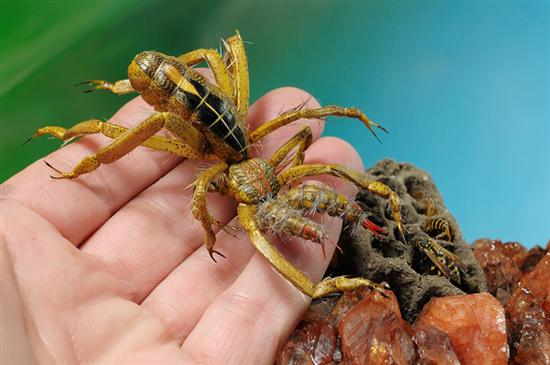
This carnivore is likely to be found munching on insects, lizards and rodents, as well as the occasional small bird. The camel spider belongs to the Solifugae order from the Arachnida class. The order has more than 1,000 known species and their size ranges from a few millimeters to 300 mm (12 in) including legs.
5. Xenesthis immanis Purple Bloom Bird-eater Spider: 23 cm

Xenesthis immanis (also known as the Colombian lesser black) belongs to the Lycosidae family. This large spider is 23 cm long and it has been known to eat live birds. It hunts alone and it is not dangerous to humans.
See more huge spiders on the next page
Written with love and coolness by Marius on December 6, 2012 in Amazing Stuff
How do you rate this article?
 (12 votes, average: 5.00 out of 5)


 The Biggest And Largest Spiders in the World
 Women giving birth to surrogate babies
 8 Crashing Cars Into Buildings
 7 Unknown Bizarre Creatures Found in 2018
eeek my friend would wet him self if he sore this
I dont know about most of these species, but Wolf Spiders are about 5 centimeters maximum, not 25. Huntsmen (i always have a couple in my house at all times) are nowhere near 30centimeters – more like 12 tops. Makes me think this page is loaded with rubbish “facts”
you are wrong australian man. This article is correct, as wikipedia also says. The only thing you are right is the wolf spiders, which normally are not that huge, but since this is an website about amazing thing maybe there are some weird spiders who are like…mutant or something
The facts in this article are based on research, and even if you can easily find out for yourself the lengths of these spiders, we will help you by providing a link towards articles where you can read about the lengths of the
– Huntsman Spider: http://en.wikipedia.org/wiki/Huntsman_spider
We have replaced the Wolf Spider with the Camel Spider, a species a lot bigger than it.
As previously stated: the facts are based on research. Research means checking MORE than ONE source. When at least 3 reliable sources give the same lengths/data/information, I’m pretty sure anyone would agree that they’re accurate. The wikipedia link was given as the most accessible source to anyone.
I like it. Yesterday I have seen two spiders and they was fucking each other to do a little spider baby.
If i saw one of those spiders in my house i would run like heck and get as far away as possible.
………??
omg these spider are so descusting i dont even no why im looking at spiders im terrafied of them and when i see them i SCEAM AHHHHHHHAA:P
The largest and most beautiful spider eastern Congo is not in your collection. It is colored black and bright yellow on its abdomen. He happens to catch small birds in its web. It’s too bad to associate science (Entomology) with sex. However, for a negro the last photo of Asian woman is crisper
“Now, besides pests, these spiders have also been known to eat birds… have a look at the picture below.”
That doesn’t exactly look like ‘research’ from three well-respected sources to me. That’s a halloween prop. [facepalm]
@Edward: That is actually not a Halloween prop, so no facepalms are needed. Golden orb wavers do feed on snakes, and on birds, the picture is documented, it is not a hoax. There are many more pictures of golden orb weavers eating birds, we did our research, please do yours.
Heyo im Kaylie im just a child so dont hate, I think these spiders are amazing at the sizes they get, and wow they look beatutiful as much as they are terrifying!
beautiful* XDDDDDD
Paige is afraid of many things, including:
-schools
-books
-especially dictionaries
-the English language in general
Seriously, how did some of you manage to pass the remedial math question to post a comment? James Cameron, we need to raise the bar!
Anywho, I found this cool page after looking to see if the Angola Witch Spider was real or not. Thank God we DON’T have arachnids the size of a side of your house, I noped the hell outta that. I’d need a can of Raid the size of a bloomin’ fire extinguisher! XD Awesome and entertaining list, though I need to take a shower now, I feel crawly and fuzzy after that. bleh! Haha!
I once stepped on a wolf spider with about a 4 to 5 inch (10 to 12 cm) legspan in Maryland. The body was probably about an inch and a half (4 cm.) It made a pretty loud crunch. (I was 9 years old then.)
I live in Florida. Wolf spiders here get bigger than my hand, are very aggressive and have a nasty bite. I’m terrified of them!